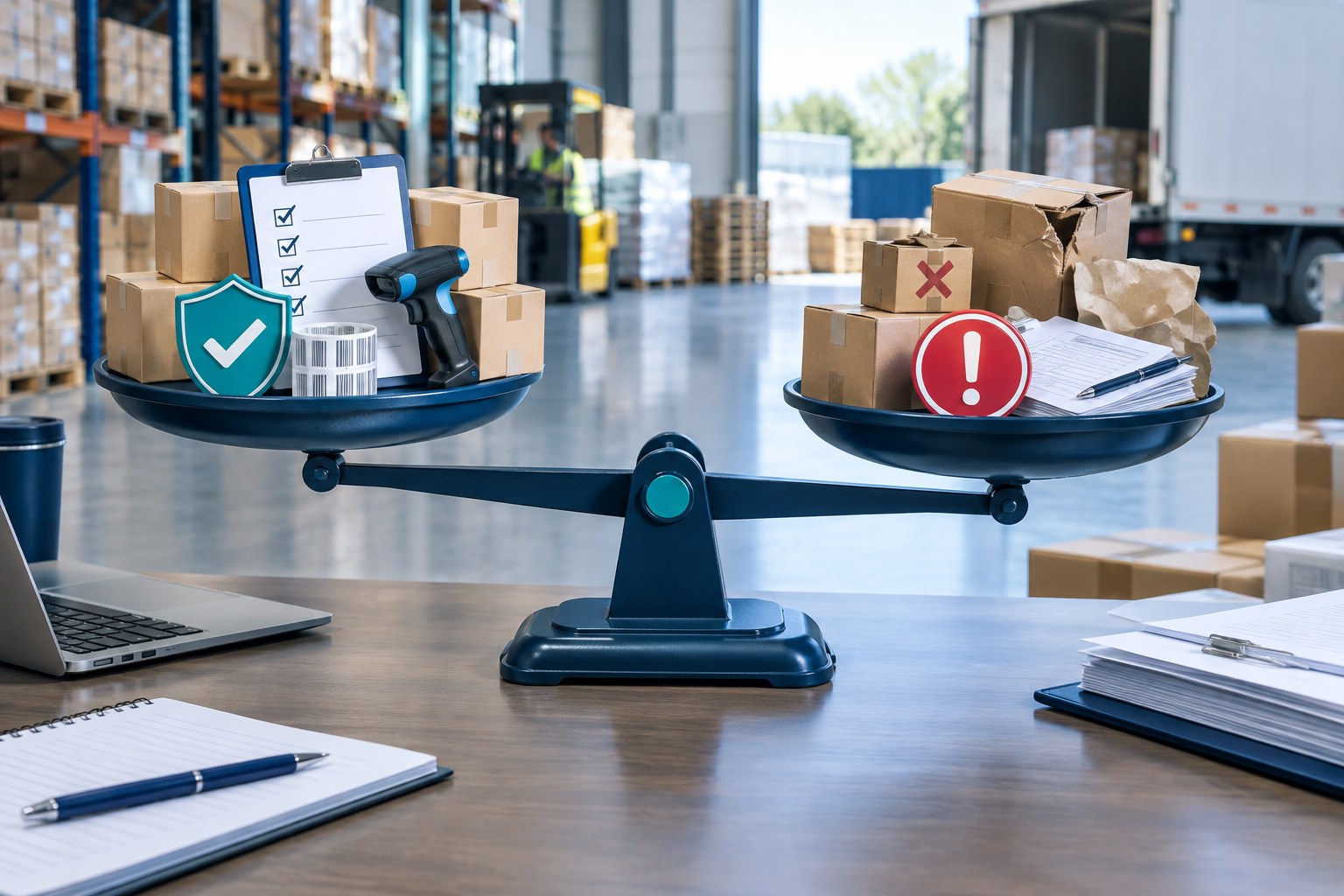
ASQ’s cost-of-quality framework distinguishes prevention, appraisal, internal failure and external failure. The examples here apply that framework to shipping administration and packaging; they are not WTM financial results.
Classify by purpose and stage
Define the boundary of your process before using “internal” and “external.” For this worksheet, an internal failure is found before delivery to the customer; an external failure is discovered after the customer receives the goods.
The same activity can have a different classification depending on why it occurs. Routine checking and rechecking after a confirmed mistake should not be automatically combined.
Calculate a simple example
Suppose a fictional shipping operation records the following monthly amounts in Canadian dollars:
Total cost of quality = $120 + $80 + $150 + $450 = $800.
Cost of poor quality = $150 + $450 = $600.
These figures are invented solely to demonstrate the arithmetic. They do not establish what another company should spend or how much a particular improvement will save.
Avoid counting the same effort twice
If the rework amount includes an employee’s time, do not add that time again under another label. Distinguish an incremental delivery recovery expense from the original planned freight charge. Keep credits, recoveries and reimbursement treatment consistent with your accounting process.
Not every consequence is immediately measurable. A customer’s inconvenience matters, but assigning it a made-up dollar value can make the worksheet less reliable. Record measured amounts and qualitative consequences separately.
Test the economics of prevention
Suppose the business considers an additional $100 monthly prevention activity. The relevant question is whether the complete result improves: fewer failures, acceptable checking effort and no harmful new delay. A lower external-failure total could be offset by more rework before dispatch, so examine the whole defined system.
Use comparable shipment volumes and a sensible observation period. The first week of a new process may not represent its normal operation.
Put records behind the numbers
Link each failure-related cost to an incident and shipment reference. Available WTM invoices, PODs and shipment history can support the transport portion, while internal labour and rework records supply the remaining evidence.
Is normal freight spending a cost of poor quality?
Not simply because it is a cost. Planned transportation fulfils the order; additional cost caused by a failure is a different category.
Should a business minimise inspection to save money?
Evaluate the whole result. Removing checking without understanding the failures it detects may shift cost rather than remove it.
Put the guide to work on your next shipment
Use the WTM Customer Portal to request a shipment, review and approve the quote, pay online and follow real-time GPS tracking. Find issued BOLs, PODs, invoices and shipment history in your account. For a new invitation, email admin@wtmlogistics.com.
For repeat shipping, ask about 10% off recurring shipments. A funded credit account separately offers up to 25% off eligible services. The applicable arrangement is confirmed with your quote; the offers are not automatically combined.