The basic calculation
For a temperature change without a phase change, the relationship is Q = m × c × ΔT. Here Q is energy transferred, m is mass, c is specific heat capacity and ΔT is the temperature change. OpenStax’s heat-transfer explanation sets out this relationship and its units.
The important distinction is between energy and time. This equation does not say how quickly heat enters a package. That requires additional information about the package and surroundings.
An illustrative water-based comparison
Use approximately 4.2 kJ per kilogram per °C for liquid water in this simplified example. Ignore the container and assume no freezing or melting. These are teaching assumptions, not a transport qualification test.
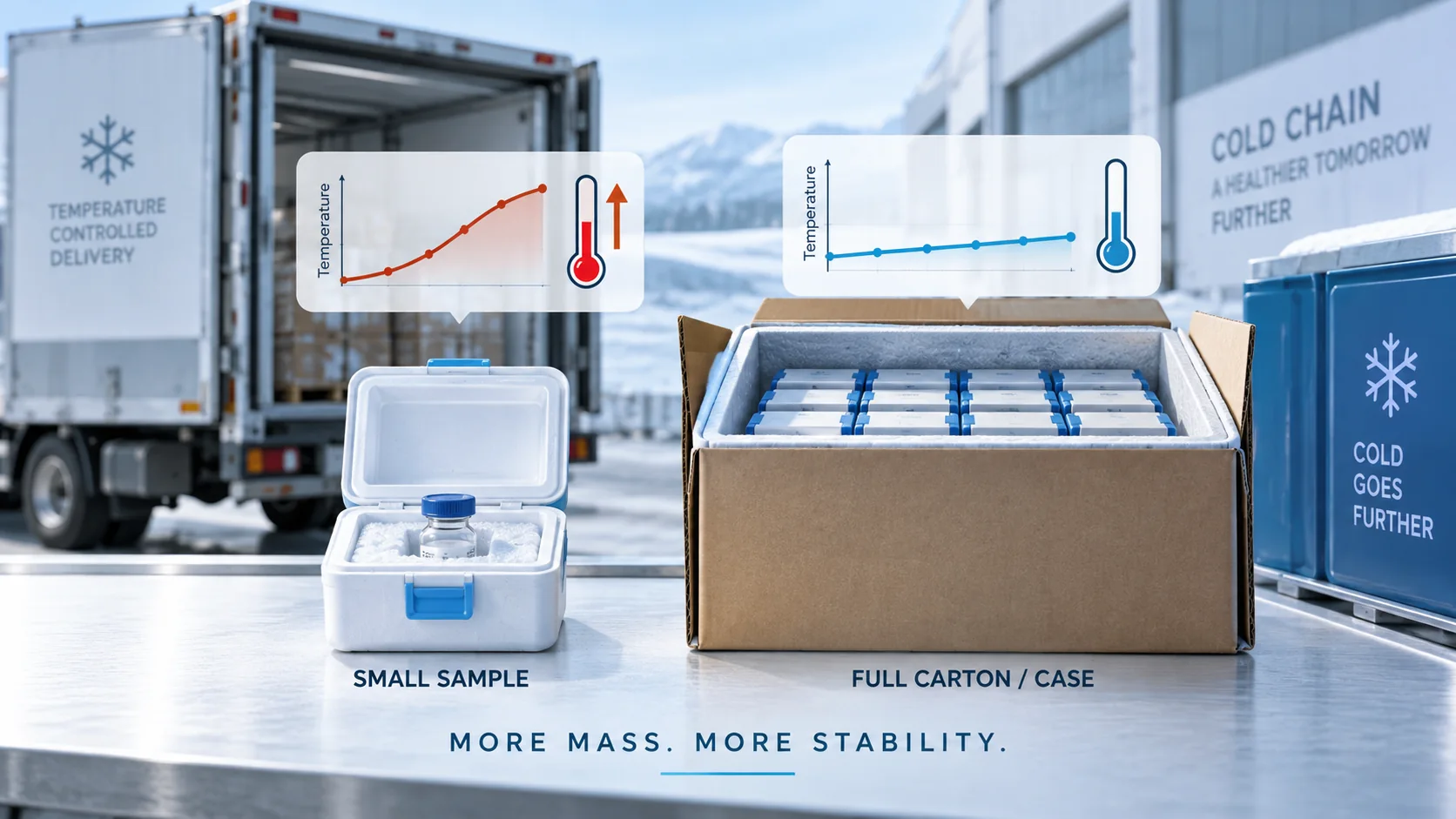
If each received exactly 8.4 kJ, the 1 kg quantity would rise 2°C while the 10 kg quantity would rise 0.2°C under those assumptions. The larger mass needs more energy for the same temperature change.
Do not conclude the larger package stays within requirements ten times longer. Heat-transfer rates, surface area, insulation, starting conditions and the product’s properties may all differ.
What changes when a case becomes a sample?
A buyer may request one small trial container from a supplier that normally ships complete cases. The product name is unchanged, but the package and thermal behaviour may not be. Ask the product owner to assess the smaller shipping configuration rather than copying an instruction designed around a larger mass.
The same reasoning applies when a partially filled insulated container is substituted for a qualified full configuration. Empty space and internal arrangement are changes to the system; a common outside box does not make the configurations equivalent.
Use the principle in a shipping brief
State the actual product quantity and packed arrangement, not just the usual order size. Include the required starting condition, transport range and receiving arrangement. Identify samples separately from the commercial load when their preparation differs.
WTM’s refrigerated courier service can carry prepared temperature-sensitive orders with the agreed equipment and handling. Tell dispatch when the shipment is a small sample so the transport request reflects that configuration. Product-specific packaging and monitoring instructions should come from the responsible owner or specialist.
Can this formula calculate how much refrigerant I need?
Not by itself. A complete thermal design must consider the package, environment, duration, heat-transfer paths and any phase changes. The simple example only explains heat capacity.
Is a heavier shipment automatically better protected?
No. Thermal mass is one factor, not a replacement for suitable packaging, refrigeration and receiving arrangements.