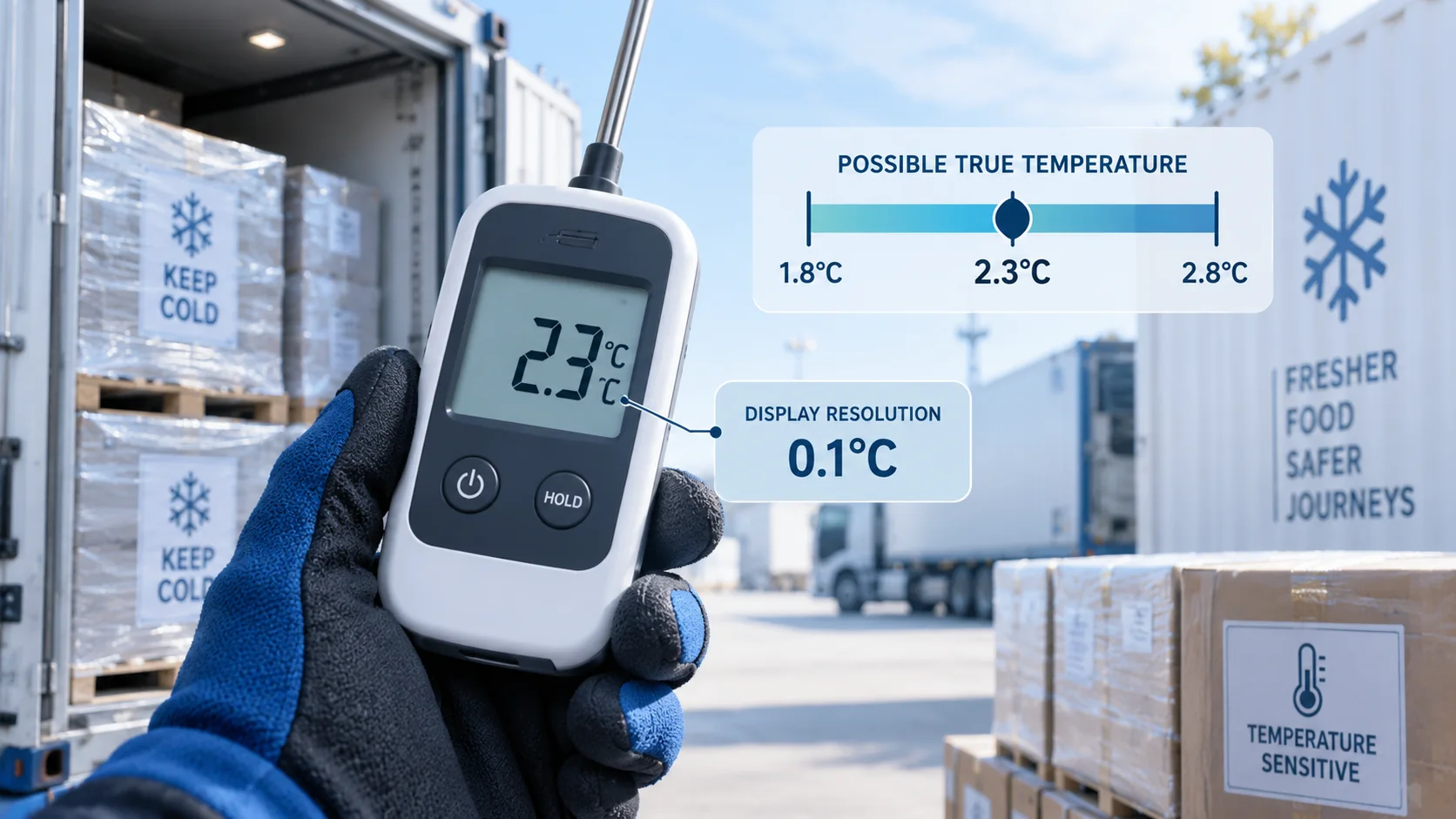
For a temperature-sensitive shipment, read the specifications before interpreting a borderline measurement. More digits can make a reading look more certain than its supporting information allows.
Four specifications that should not be confused
As a concrete manufacturer example, the Testo 184 T2 specification lists 0.1°C resolution and ±0.5°C accuracy. These figures illustrate two different specifications; they do not identify the device used by WTM or establish the uncertainty of a particular shipment measurement.
Calibration information and measurement conditions may also matter. A complete assessment considers the measurement system, not just the display.
Work through a reading
For illustration, take a displayed value of 4.0°C and a device specification of ±0.5°C applicable to the situation. Adding and subtracting that specification gives 3.5–4.5°C. This is a simple way to visualise the stated device tolerance—not a calculated confidence interval or complete measurement-uncertainty budget.
The tenths digit does not reduce that interval to 3.9–4.1°C. Likewise, writing the result as 4.00°C in a spreadsheet does not improve the underlying measurement.
These temperatures illustrate arithmetic, not a universal food or pharmaceutical acceptance limit. A product decision needs its own approved rules, measurement method and competent interpretation.
Compare like with like
Before disputing two readings, establish whether both devices measured the same thing at the same time. One might measure return air while another measures air inside a carton. Even identical devices can report different values when placed in different conditions.
Record sensor identification, location, timing, units and relevant calibration information. Preserve the original report. If the manufacturer gives different accuracy specifications over different ranges, use the applicable one rather than the most attractive number in a brochure.
Make reporting requirements specific
A request for “accurate temperature records” should explain the required range, measurement location, interval and documentation. This allows the equipment and reporting arrangement to be assessed before transport instead of after a disputed delivery.
WTM can plan refrigerated transportation around the shipment’s stated requirements. GPS location information and the POD remain separate records; neither replaces the specified temperature measurement.
Does a one-minute logging interval mean the sensor responds instantly?
No. Storage frequency and physical response are different. Read both specifications for the selected device.
Does calibration mean a reading has zero error?
No. Calibration provides information about measurement performance under defined conditions. It is not a claim of perfect agreement in every later use.