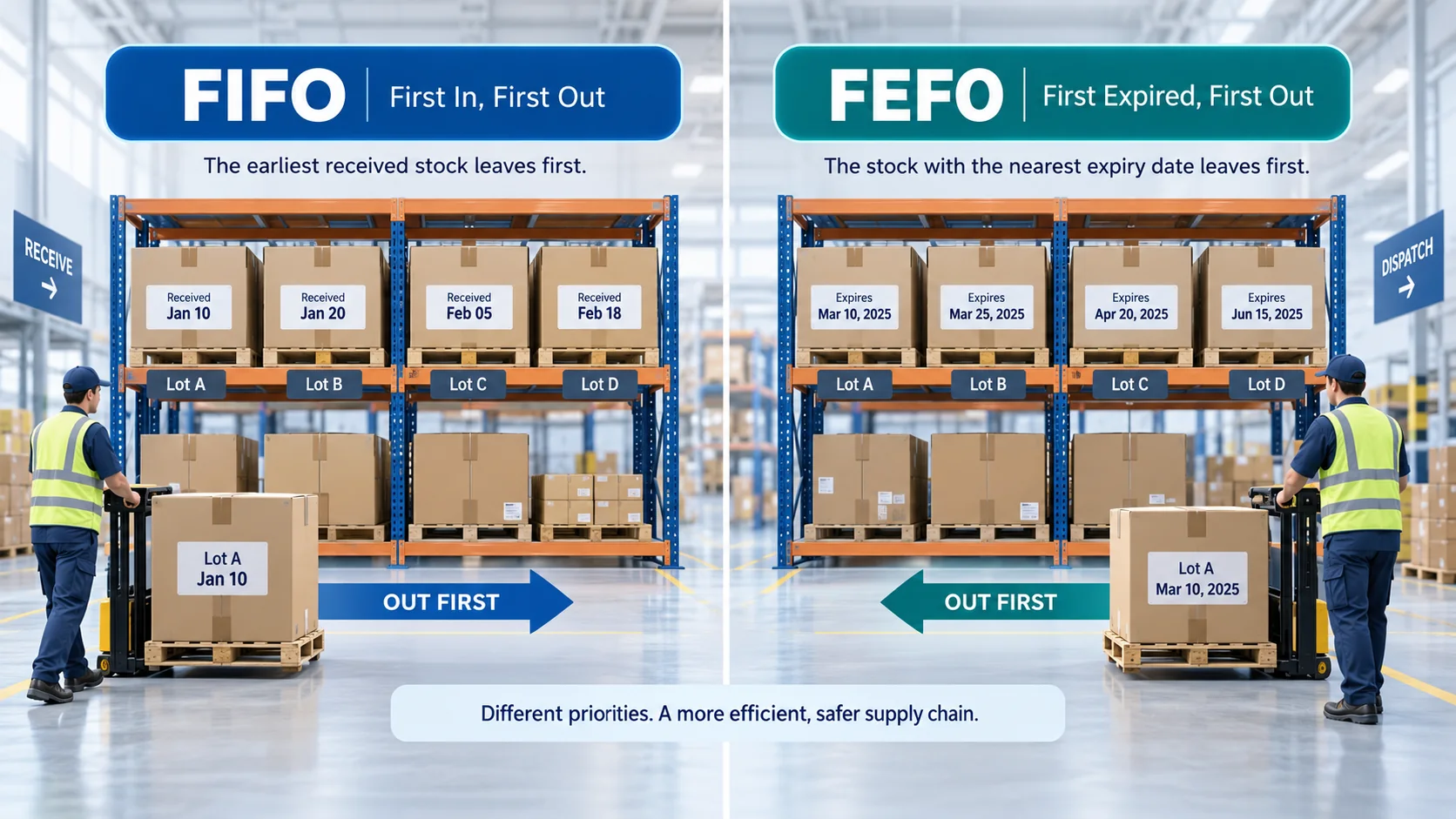
Receipt order and expiry order can disagree
Microsoft’s Business Central FEFO explanation describes selecting items with the earliest expiry dates first. Its software implementation also has specific tracking and configuration rules. The concept is useful beyond that product, but a business still needs its own eligibility and release process.
Consider these fictional lots of the same product, all available and otherwise suitable on September 30:
FIFO would start with A because it arrived first. FEFO would start with B because its recorded expiry is earliest. This is a stock-selection example, not a recommendation for handling any particular food or medical product.
Apply eligibility before rotation
The oldest or earliest-expiring lot is not automatically eligible for every order. A customer may require a minimum remaining shelf life at receipt, a particular approved lot or another documented specification.
Suppose the fictional customer receives on October 2 and requires at least 14 days of remaining life. Lot B’s October 10 date would not meet that requirement. The process should select from the eligible lots instead of sending B simply because it appears first in the FEFO list.
Date-label meanings depend on the product and applicable requirements. Do not casually substitute a best-before date, manufacture date and expiry date in one field and expect the picking rule to remain meaningful.
Give the picker the information needed
A useful record contains the product identifier, lot, quantity, location, relevant date and release status. The picker needs to know whether stock is available, reserved or held for review. A system cannot apply a date-based policy correctly when the dates are missing or entered inconsistently.
Use a defined tie-breaker when eligible lots share the same date. Record exceptions instead of quietly overriding the rule, so purchasing and quality teams can understand why a lot remains in stock.
Connect the pick to transportation
A dispatch plan should preserve the chosen lot’s identity and satisfy its transport requirements. Identify the actual delivery date used in any remaining-life calculation; an order-picking date and customer receipt date are not interchangeable.
WTM can arrange the corresponding courier, refrigerated or freight movement. Share temperature and receiving requirements when booking. Transport visibility helps coordination, but choosing and releasing the correct product lot remains a distinct responsibility.
Is FEFO always better than FIFO?
Not for every product or business process. Choose the policy that fits the goods and customer requirements, then apply it consistently to eligible inventory.
Can a fast delivery solve the wrong-lot problem?
No. Speed does not correct an unsuitable lot selection. Resolve the product eligibility question before dispatching the shipment.
Put the guide to work on your next shipment
Use the WTM Customer Portal to request a shipment, review and approve the quote, pay online and follow real-time GPS tracking. Find issued BOLs, PODs, invoices and shipment history in your account. For a new invitation, email admin@wtmlogistics.com.
For repeat shipping, ask about 10% off recurring shipments. A funded credit account separately offers up to 25% off eligible services. The applicable arrangement is confirmed with your quote; the offers are not automatically combined.