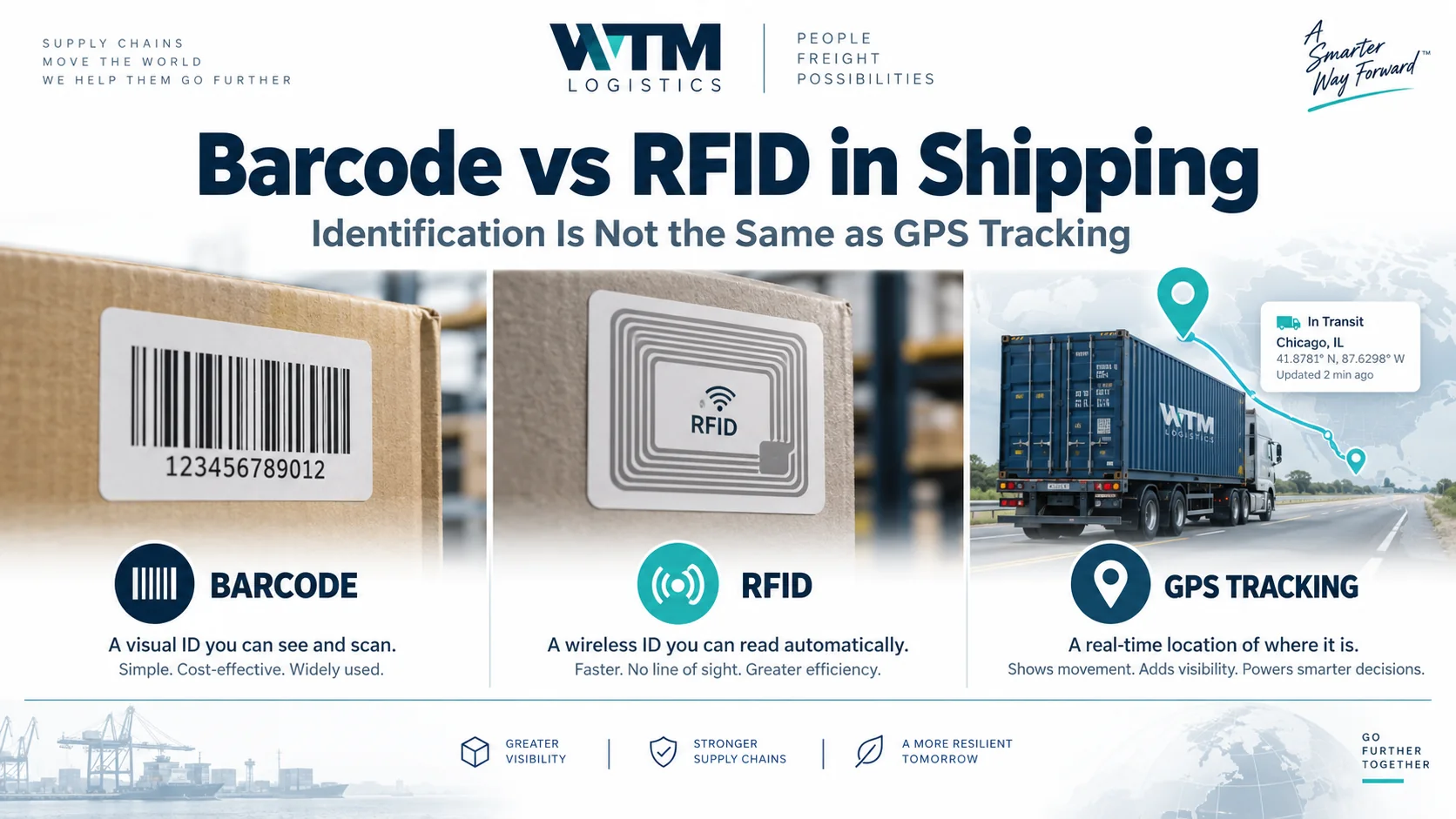
Start with the question you need answered
For a warehouse worker, the question may be “Which pallet is this?” For a dispatcher, it may be “Where is the vehicle?” For the buyer, it may be “Did my complete order arrive?” One data point rarely answers all three.
GS1’s RFID guidance explains how radio-frequency identification can read identifiers without the direct line of sight needed for a conventional visible barcode scan. The practical result still depends on the tags, readers and operating environment; an RFID label is not automatically a long-range locator.
An example with one missing carton
Imagine a buyer expects three cartons. The vehicle’s location confirms arrival at the buyer’s address. That does not establish that all three cartons were unloaded.
A receiving check that matches three carton identifiers gives different evidence from a vehicle map. If only two identifiers are recorded, investigate whether the third carton was missing, unreadable, grouped under another identifier or simply not checked. Do not assume technology has answered a question that the process never asked.
The association matters as much as the label
Useful tracking connects an identifier to a shipment, a physical event and the right receiver. A beautifully printed barcode with no relationship to the order is not an effective delivery record.
When designing a simple process, write down what a scan means: collected, loaded, transferred or delivered. Avoid using one generic “scanned” entry for several different steps. Define how damaged labels and manual entries are handled so staff do not create a second identity for the same carton without explanation.
What a shipper should ask
Ask whether the available visibility is a milestone history, live vehicle tracking or an item-level receiving record. Ask what the recipient can see and which reference connects the records. These questions are more useful than asking whether a provider “has tracking.”
WTM offers real-time GPS shipment visibility through its Customer Portal, together with available PODs and other shipment documents. This explanation does not state that WTM uses RFID for every package or provides item-level inventory verification as standard.
Can a barcode contain more than an identification number?
Yes, depending on its format and use. The key point is that encoded information and a live location update are different things.
Should I buy RFID tags to ship an occasional box?
Start with the carrier’s actual labelling instructions and your receiver’s requirements. Do not buy a technology before establishing the problem it needs to solve.