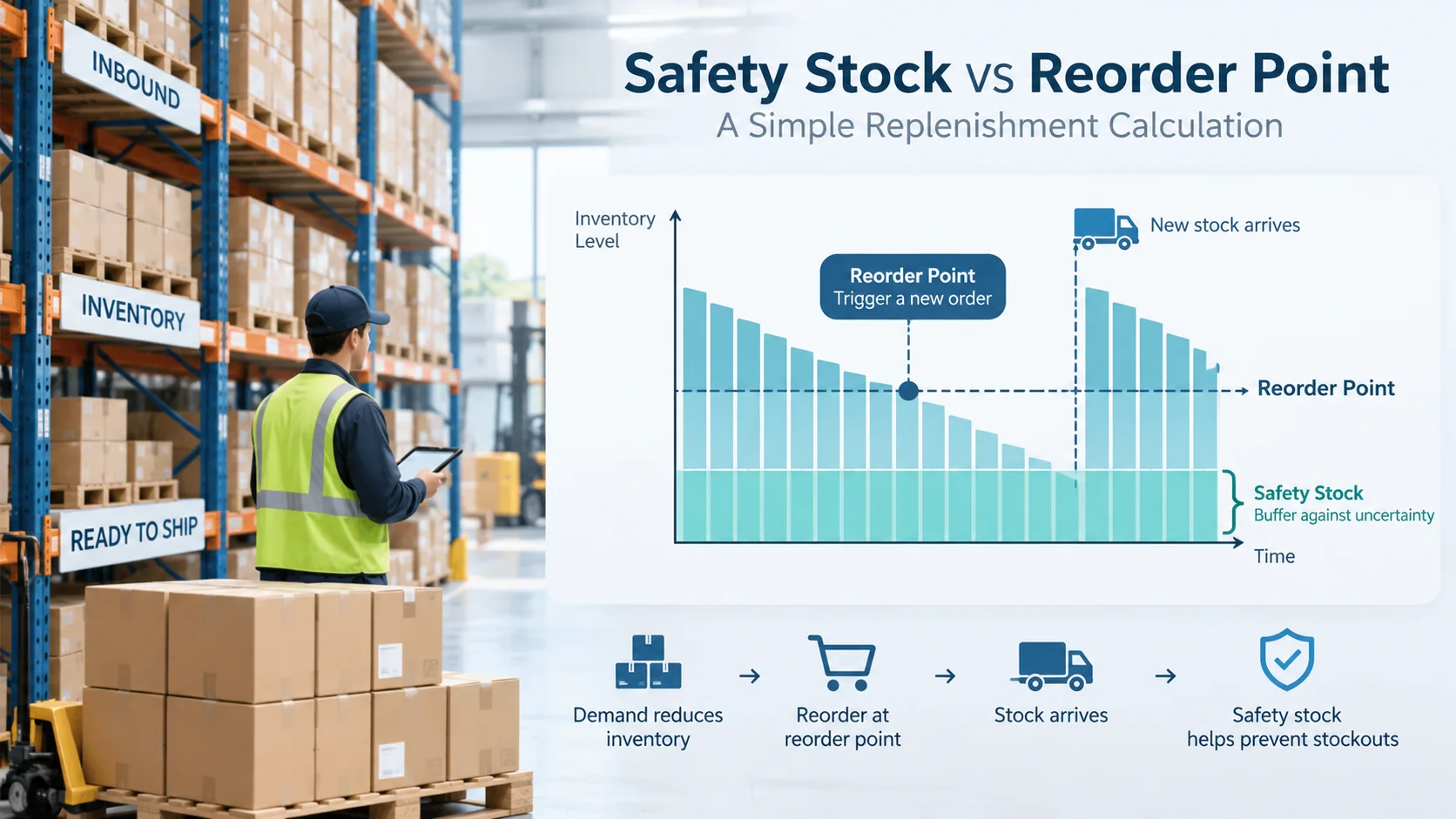
Start with a transparent formula
A basic model is reorder point = expected demand during replenishment lead time + safety stock. Oracle’s inventory-planning documentation describes this relationship and includes more than the driving leg in replenishment lead time.
For a simple constant-demand example, expected lead-time demand equals average daily demand multiplied by lead time in days. Use consistent operating or calendar days; do not mix a seven-day demand average with a working-day lead time without adjustment.
A worked example
Assume a fictional repair supplier uses 20 units per operating day. Replenishment takes four operating days, and the business has independently chosen a 30-unit safety stock.
The 30-unit buffer is an assumption for teaching the calculation, not a recommended level for every business. Choosing a buffer requires information about demand, lead-time variation and the consequences of shortages.
Do not look only at the shelf
Under a common inventory-position approach, consider on-hand stock plus qualifying stock on order, less backorders. Other systems account for reservations differently, so use the definition that matches your records and avoid subtracting the same commitment twice.
Suppose on-hand stock is 70, qualifying stock on order is 50 and backorders are 20. The resulting position is 70 + 50 − 20 = 100 units. With a trigger defined as at or below 110, this example calls for a replenishment decision.
The reorder point does not tell you the quantity to buy. Pack sizes, minimum orders, demand and purchasing policy determine that separately.
Transport belongs inside the replenishment plan
Map the period from placing an order to having usable goods: supplier preparation, collection, transport, receiving and any necessary release checks. Faster driving only changes one part. A late purchase-order approval or closed receiving department may dominate the overall lead time.
Use actual shipment history to understand transport performance, alongside your purchasing and receiving records. WTM’s scheduled delivery arrangements can support a recurring supply pattern, while an urgent exception should be identified separately rather than used to conceal a persistent ordering problem.
Does safety stock guarantee no shortages?
No. It is a planning buffer under assumptions, not protection against every demand spike or supply interruption. Review the policy as the operating pattern changes.
Should I lower the reorder point whenever a carrier quotes faster transit?
Only after evaluating the complete, reliable replenishment lead time and your chosen service policy. A best-case trip is not the same as the lead time on which inventory depends.
Put the guide to work on your next shipment
Use the WTM Customer Portal to request a shipment, review and approve the quote, pay online and follow real-time GPS tracking. Find issued BOLs, PODs, invoices and shipment history in your account. For a new invitation, email admin@wtmlogistics.com.
For repeat shipping, ask about 10% off recurring shipments. A funded credit account separately offers up to 25% off eligible services. The applicable arrangement is confirmed with your quote; the offers are not automatically combined.