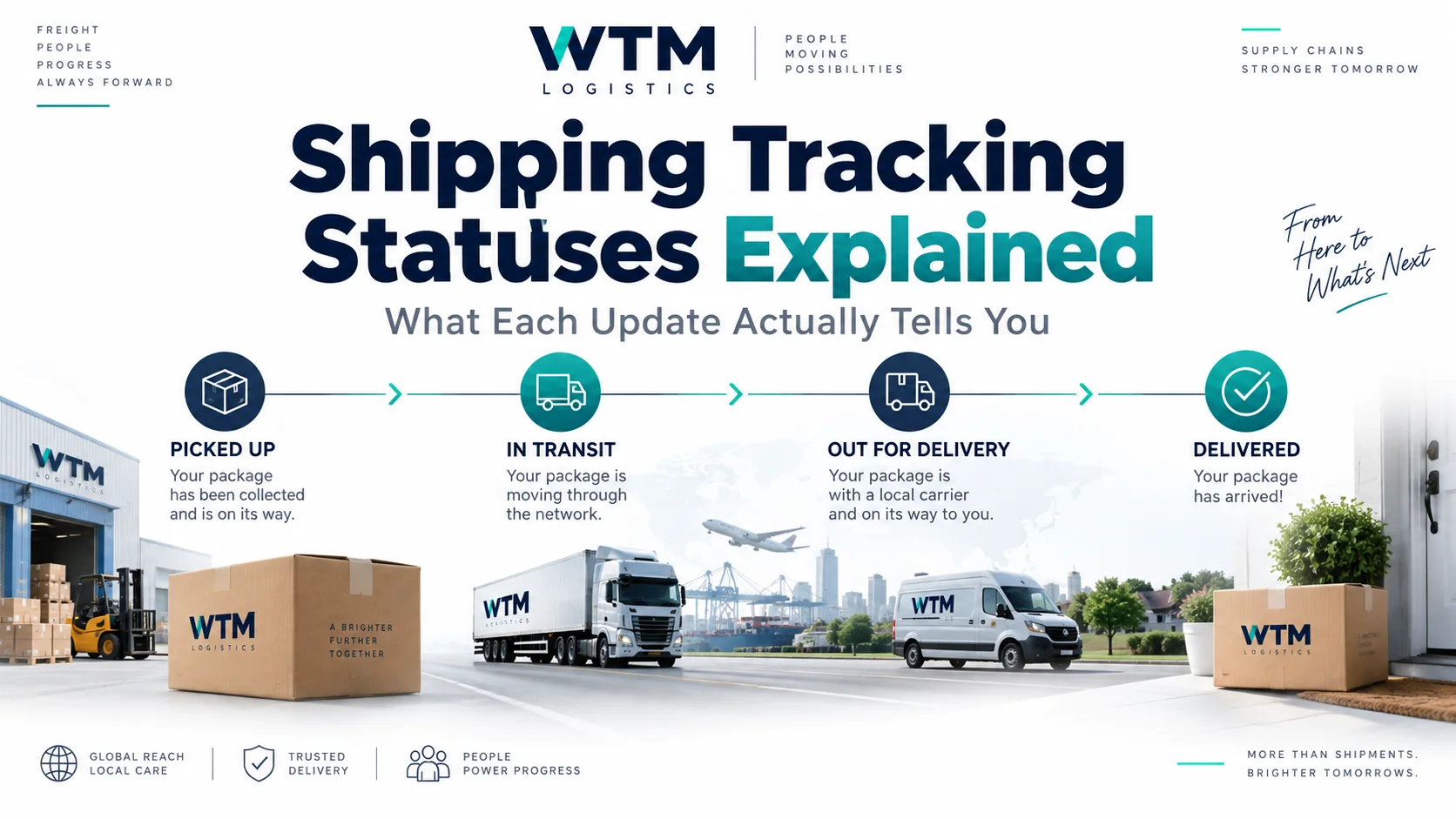
Four common statuses, four different meanings
Carrier wording varies. In its tracking-status guide, UPS distinguishes electronic shipment information from possession, movement through its network, final delivery dispatch and completed delivery. Use the following as a reading aid, not as a promise that every courier uses identical labels.
Separate the event from the promise
A tracking milestone is evidence of progress. A promised delivery date is the commitment agreed for the shipment. An estimated arrival is a forecast. Keep all three visible when making decisions.
For example, suppose a boxed part is required at a workshop by 3 p.m. A 10 a.m. “out for delivery” update is useful, but it does not independently confirm arrival before the workshop’s deadline. The relevant question is whether the booked service still meets that receiving requirement.
Conversely, a parcel without a fresh update should not automatically be labelled lost. UPS notes that a long-distance shipment may remain in its moving status without another scan until the destination hub. That is an explanation of one carrier’s scan process, not a reason to ignore an overdue commitment.
Ask a question that can be answered
Instead of asking only “Where is it?”, attach the shipment reference and state the decision you need to make: “Our receiver closes at 4 p.m.; is delivery still expected before then?” For a delivered shipment, ask for the handoff details and available proof of delivery rather than repeatedly requesting an ETA.
A useful enquiry contains the last visible event and time, the receiving deadline, and the contact who can accept the goods. Do not send a customer-order number alone when the courier needs a different shipment reference.
Use location and delivery records for different jobs
WTM customers can follow active shipments with real-time GPS tracking through the WTM Customer Portal. Tracking helps coordinate the incoming vehicle; the POD records the completed handoff. Available invoices and shipment history answer later administrative questions.
A store manager, for example, can follow an incoming delivery and alert receiving staff. After arrival, the accounts team can use the shipment’s documents without treating a map screenshot as proof that the order was signed for.
Does “delivered” mean the end user has unpacked the order?
Not necessarily. An authorised reception or warehouse handoff may precede the business’s own internal distribution. Check the recorded receiver and delivery instructions.
Should I report an unexplained tracking gap?
Yes when it affects an agreed deadline or the information is inconsistent. Give the carrier the reference and the specific concern so it can investigate the right movement.