WTM Logistics · Shipping questions answered
Some sealed liquids can travel by courier, but the product must be identified before the service is booked. WTM Logistics can review a prepared, non-hazardous liquid shipment within its coverage and match the transport to its handling or temperature requirements. “A few bottles” is not enough information to distinguish ordinary goods from products needing a different transport arrangement.
Practical answers for parcels, pallets and business freight
Real-time GPS tracking · WTM Customer Portal
Name the product, not just the container
Give the commercial product name, the number of containers and the volume in each. For business products, provide relevant supplier information or a safety data sheet when needed. Do not decide that a substance is non-hazardous solely because it is sold in a household-sized bottle.
This guide concerns ordinary, accepted non-hazardous shipments. Aerosols, fuels, corrosives, infectious materials and other regulated goods need a separate review. Tell WTM what is present rather than hiding it under a generic description such as “samples.”
Containment and protection are different jobs
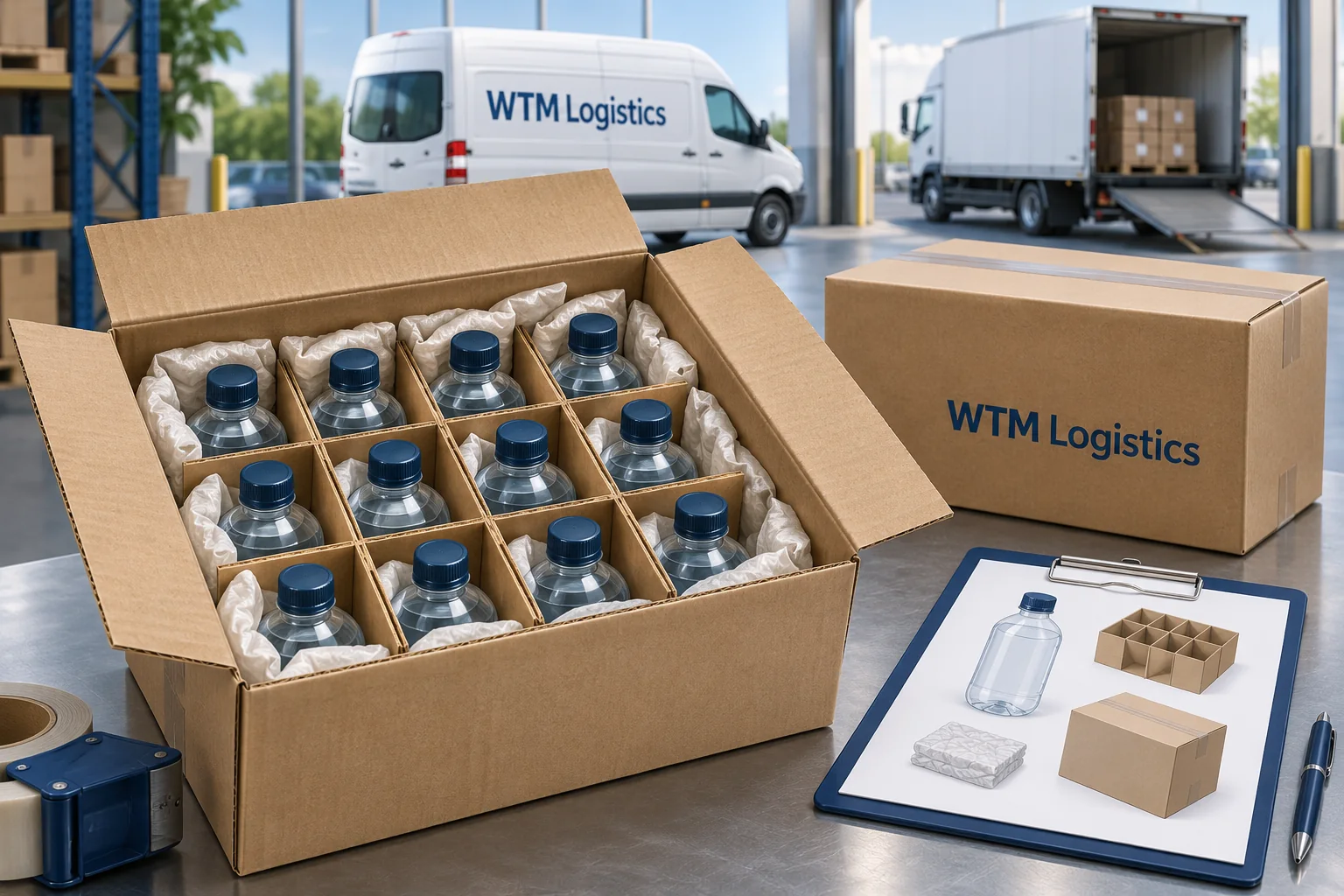
The immediate container needs a suitable closure, while the outer package needs to protect and contain the prepared items. Bottles should not strike each other or place their caps under pressure from neighbouring contents.
Canada Post’s liquid-packing examples describe inner and outer containers and absorbent protection. Those are postal instructions, not a blanket WTM acceptance standard. They illustrate why an apparently sealed bottle still needs a complete packaging plan.
Describe the final carton, crate or tote, including its gross weight. State whether it must remain upright and whether it can be stacked. An arrow on the carton should support an agreed handling instruction, not substitute for one.
Declare temperature needs separately
A sealed container does not establish whether the contents can travel at ordinary vehicle temperature. Use the supplier’s transport instructions and specify any required range or protection from freezing. A refrigerated movement is a different service from a standard dry parcel run.
For a box of ordinary packaged food liquids, identify the storage and transport conditions as well as the package count. For non-food commercial goods, provide the actual product information. A blanket “keep cool” note can mean different things to different people.
Plan a receiver who can deal with the shipment
Give a staffed delivery point and the receiving window. The recipient should know what containers are expected and where the goods will go after handoff. For cartons that must not be left unattended, state that requirement before booking.
Use the same reference on the request, package and available delivery record. GPS tracking can help coordinate arrival; it does not certify the contents’ temperature or condition.
Can I mix liquids and other items in one box?
Disclose the full contents and packaging. Compatibility, leak containment and protection must be considered before the package is accepted; putting everything on one order does not make it one suitable package.
Can WTM transport a product sample for my business?
Request a quote with the product identity, container sizes and transport instructions. “Sample” describes the purpose of the shipment, not its transport classification.
Send WTM the exact product and prepared package details. We will quote the suitable courier or temperature-controlled movement for the accepted shipment.
From your shipping question to a booked delivery
Use the WTM Customer Portal to submit a request, review the quote and approve the service. Pay online, follow the shipment with real-time GPS tracking, and retrieve issued delivery documents and invoices. Contact admin@wtmlogistics.com for a new account invitation.
Ready to arrange the shipment? Send WTM your pickup and delivery details, prepared shipment information and deadline.
