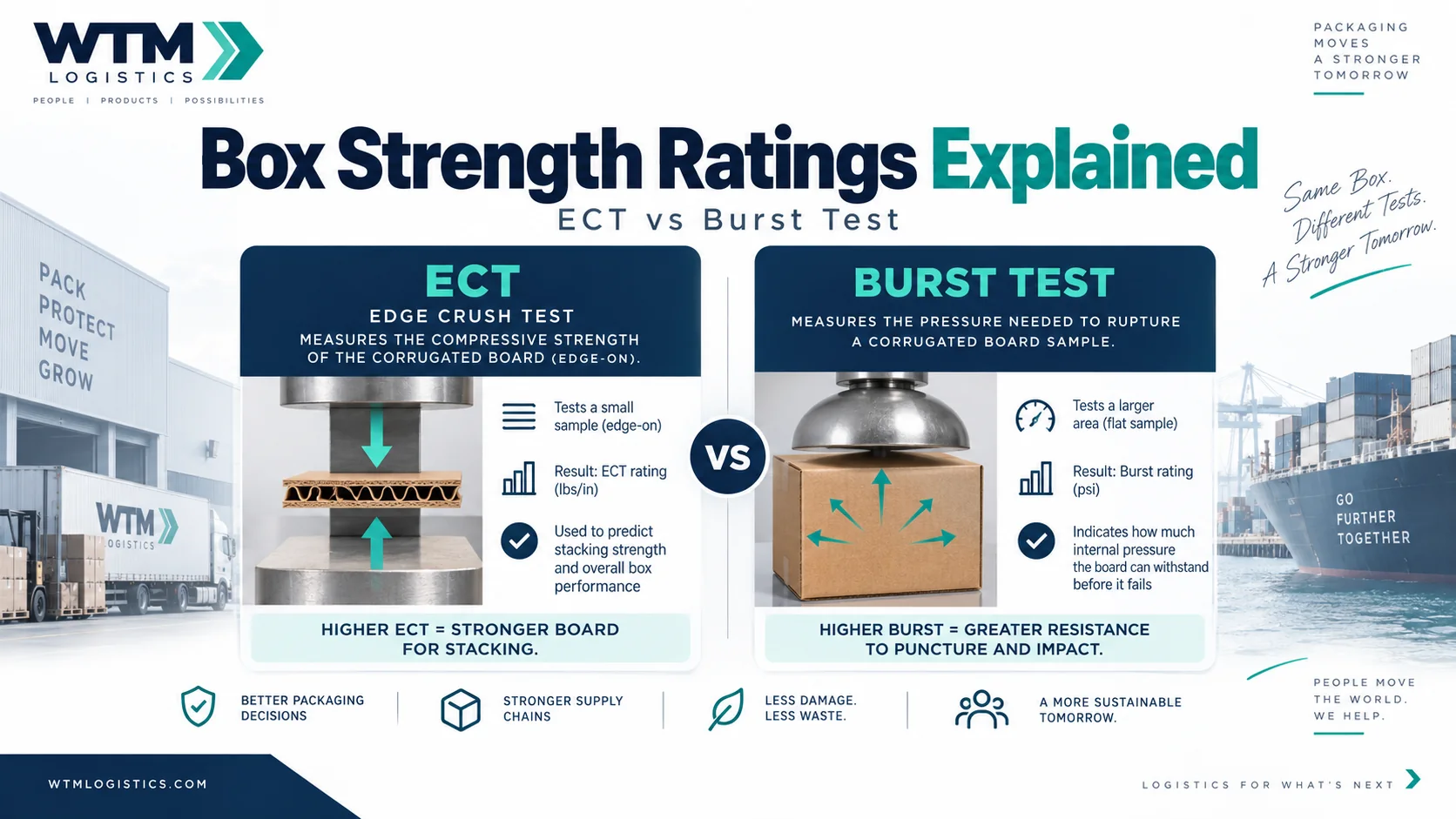
Edge Crush Test, or ECT, and burst-strength ratings measure different properties of corrugated packaging. ECT concerns resistance to compression at a board edge; burst testing concerns resistance to pressure through the board. Neither number, on its own, is a universal maximum weight for a finished parcel.
By WTM Logistics · Practical explanation with primary-source references and clearly labelled examples
Conceptual illustration, not a testing procedure. See the article for the test definitions and limitations. Click the image to enlarge.
Read the unit, not just the large number
A packaging supplier may describe board as 32 ECT or 200-pound test. Uline’s terminology guide distinguishes an edge-crush value expressed per linear inch from a burst rating expressed per square inch. The two numbers should not be compared as though 200 is simply a stronger version of 32 on one scale.
Marking or specification
What it describes
What not to conclude
ECT
Edgewise compression performance of the board
“32 ECT means the contents may weigh 32 lb”
Burst strength
Pressure resistance through the board
“200-pound test means a 200 lb parcel”
Finished package weight limit
An applicable limit or recommendation for a particular package/service
A guarantee against every distribution hazard
Box dimensions
Size of the carton, with inside/outside distinction
Enough protection for the contents without checking the packing
The package is more than a board sample
Two parcels can use the same board grade and behave differently because their construction and contents differ. Ask the packaging supplier about the completed design, intended contents and transport environment rather than selecting solely from one printed rating.
For a practical comparison, imagine two fictional shipments: a carton of lightweight textile items and a compact metal component with a projecting edge. Their gross weights might match, yet the second also needs a design addressing concentrated contact and internal movement. A single board number does not make those requirements identical.
Write a useful packaging enquiry
Tell the supplier the item dimensions and weight, how it will be supported, whether cartons will be stacked, and how the package will be handled. Ask which test evidence relates to that complete arrangement. Request the recommendation in terms that purchasing and packing staff can reproduce.
Keep a sample specification with the box code, closure method and internal materials. Otherwise, a later substitution may retain the same outside size while changing the package you thought had been evaluated.
Do not convert a test label into a freight instruction
A carrier still needs the actual packed size, gross weight and handling requirements. A carton rating is not a replacement for those measurements, and it does not authorise stacking loads above the package.
For WTM collections, provide the finished shipment dimensions and explain any restriction on orientation or loading. Where a carton no longer provides appropriate handling, discuss the shipment’s packaging design with the supplier before choosing parcel or freight transport.
Is ECT the same as a full-box compression test?
No. An edge-crush test addresses board performance; a completed package presents a different test question. Ask exactly what specimen and method produced the result you are using.
Can I reuse an old carton because its original rating is high?
The original marking does not assess its current condition or your new contents. Inspect the carton and obtain appropriate packaging advice rather than treating an old rating as a fresh approval.
Use the WTM Customer Portal to request a shipment, review and approve the quote, pay online and follow real-time GPS tracking. Find issued BOLs, PODs, invoices and shipment history in your account. For a new invitation, email admin@wtmlogistics.com.
Get a shipping quote
Send the details of your actual shipment. WTM’s quote-response commitment is within 15 minutes.