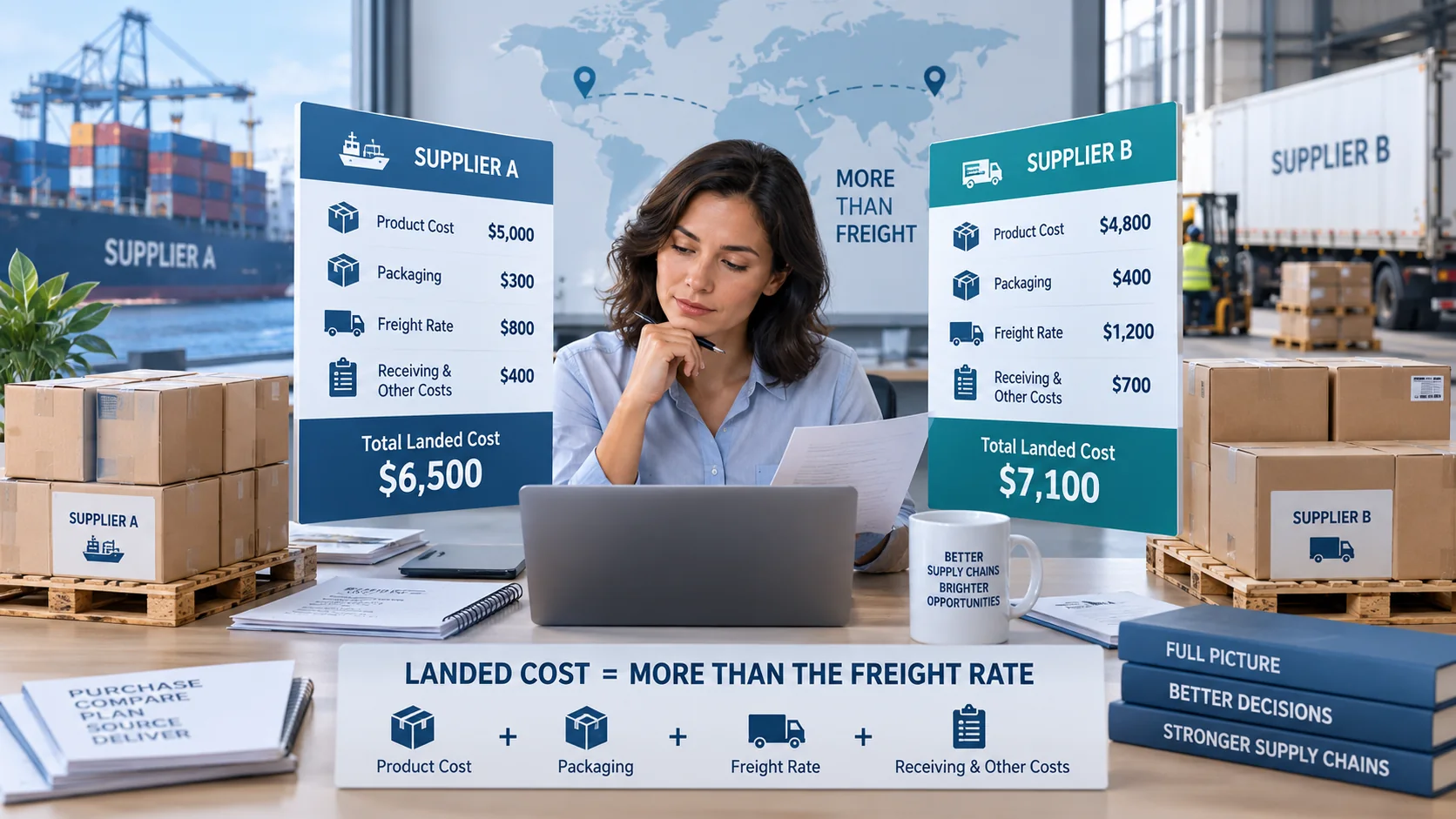
Oracle’s landed-cost explanation describes acquisition cost as extending beyond the goods price to associated charges. The comparison below is a domestic purchasing illustration, not a tax, customs or accounting-policy calculation.
Put each offer on the same basis
Compare the same quantity, quality and receiving requirement. Include each cost once, and identify whether it is already included in another line. A delivered supplier price and an ex-warehouse price cannot be compared sensibly without accounting for that difference.
For this fictional example, both suppliers offer 100 equivalent units to the same receiver. All amounts are illustrative Canadian dollars; taxes, duties, financing and product-quality differences are outside the example.
Supplier A has the lower product price, but Supplier B is $100 lower on the defined total. That conclusion is limited to these inputs; it is not a reason to select a supplier without considering service and product suitability.
Avoid double counting
If packaging is included in the goods price, do not add it again. If the transport quote includes a particular handling service, identify that inclusion before creating a separate allowance for the same work.
Distinguish costs incurred for this shipment from fixed overhead that would exist either way. A marginal buying decision and a full-cost reporting policy may allocate different amounts. State which decision your worksheet supports.
Do not ignore the delivery requirement
A lower calculated cost is not a useful comparison when the goods arrive after they are needed. Put the required receiving date beside the totals. Where one option depends on a flexible delivery window, make that assumption visible.
Likewise, a dock-to-dock quote and a quote including a necessary tailgate service cover different jobs. Use the real pickup and receiving conditions, not the lowest advertised starting price.
Ask for transport information that supports the calculation
Give WTM the origin, destination, finished package dimensions, gross weight and receiving requirements. That allows the freight quote to fit the purchase you are comparing. Match the approved quote, supplier order and available invoice to keep the record consistent.
For recurring purchasing, compare several representative shipments instead of selecting the most convenient isolated example. A useful policy should fit the business’s usual order mix.
Is landed cost always the amount on the carrier invoice?
No. The carrier invoice is one component; other acquisition costs may come from the supplier or another provider.
Can I include tax in this worksheet?
Use your accountant’s applicable treatment and define the comparison consistently. The example intentionally excludes tax rather than assuming it is always a cost or always recoverable.