Define the measurement event
Some systems report allocation completeness, others shipment completeness. Oracle’s retail metric documentation distinguishes quantity and line-based measures. The worksheet here uses the initial dispatch for each order, not later backorder recovery or final delivery.
For this guide, unit fill rate is dispatched units divided by requested units. A complete line has its full requested quantity dispatched. A complete order has every line complete. All requested quantities must be positive, and over-shipment is not used to offset another shortage.
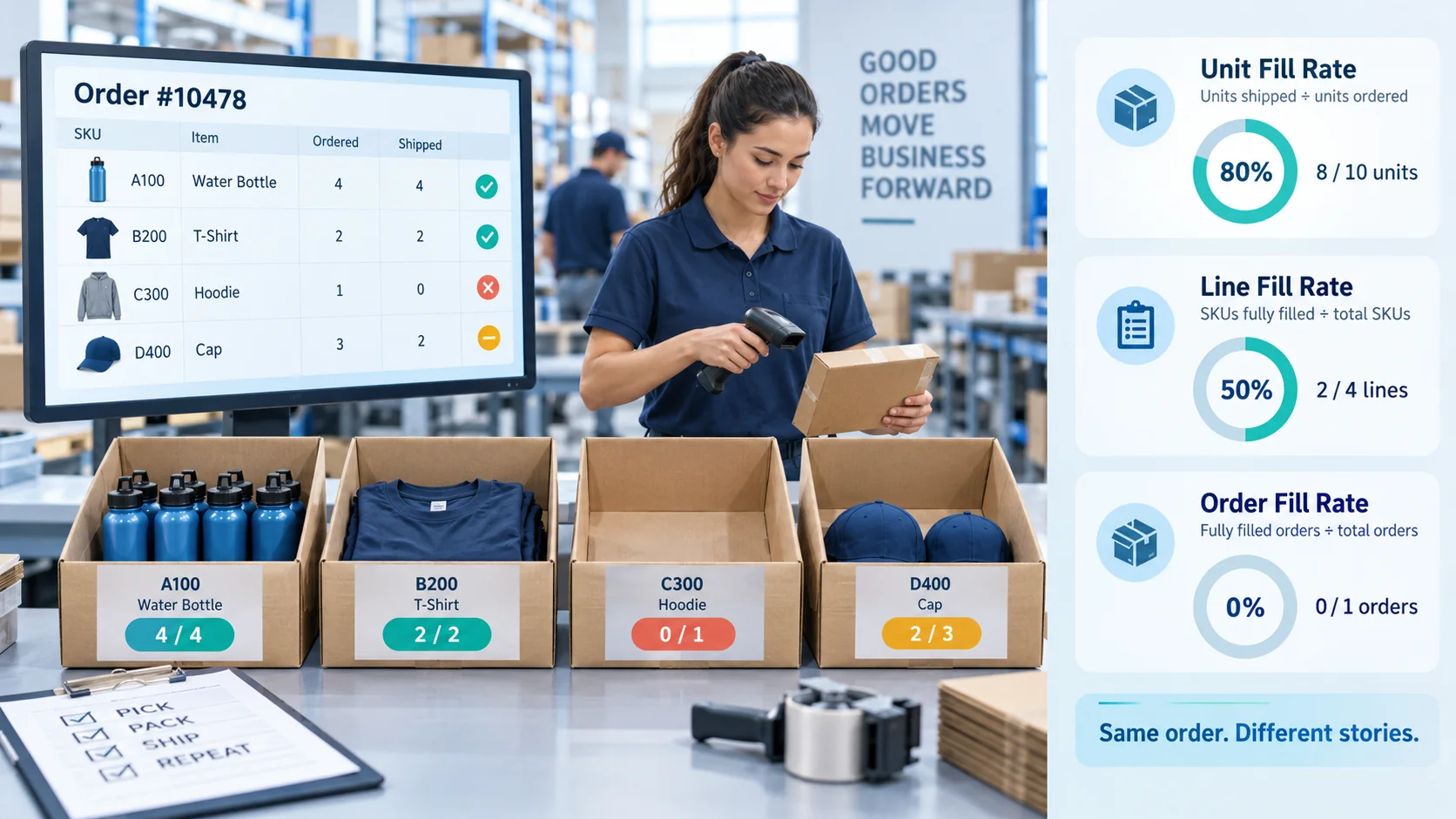
One dataset, three answers
The following transactions are fictional. Treat each unit as countable within its order line.
There are 30 requested units and 27 initially dispatched units. Two of the four lines are complete. Only Order 2 is complete.
Unit fill rate: 27 ÷ 30 × 100 = 90%.
Line fill rate: 2 ÷ 4 × 100 = 50%.
Order fill rate: 1 ÷ 3 × 100 = 33.3%, rounded.
The 90% figure is mathematically correct, yet two customers still have incomplete orders. That is why a single percentage may give an incomplete management picture.
Keep comparisons meaningful
Choose one population of orders and state whether cancelled lines, substitutions and backorders count. Preserve the original required quantity when measuring the original promise; silently lowering it after a shortage changes the question.
Do not average weekly percentages without considering their denominators. A week containing ten units should not automatically carry the same weight as a week containing ten thousand when calculating the overall unit rate.
Separate supply completeness from delivery performance
An order can be dispatched complete and arrive late. Another can arrive on time but be missing goods before it even left the supplier. Fill rate alone does not establish transport reliability, and a carrier should not be assigned a supplier shortage merely because the customer discovered it at delivery.
For WTM shipments, associate the supplier’s packed quantities with the transport record and the receiving observations. The Customer Portal’s shipment documents can support the handoff evidence, while the seller’s order system supplies the requested quantities.
Is order fill rate the same as OTIF?
No. Under this guide’s definitions, order fill rate measures initial-dispatch completeness. OTIF also evaluates a defined on-time requirement at its specified event.
Which fill rate should a business use?
Use the measures that answer its decisions, with documented definitions. Reporting units, lines and orders together can reveal a problem that one aggregate hides.