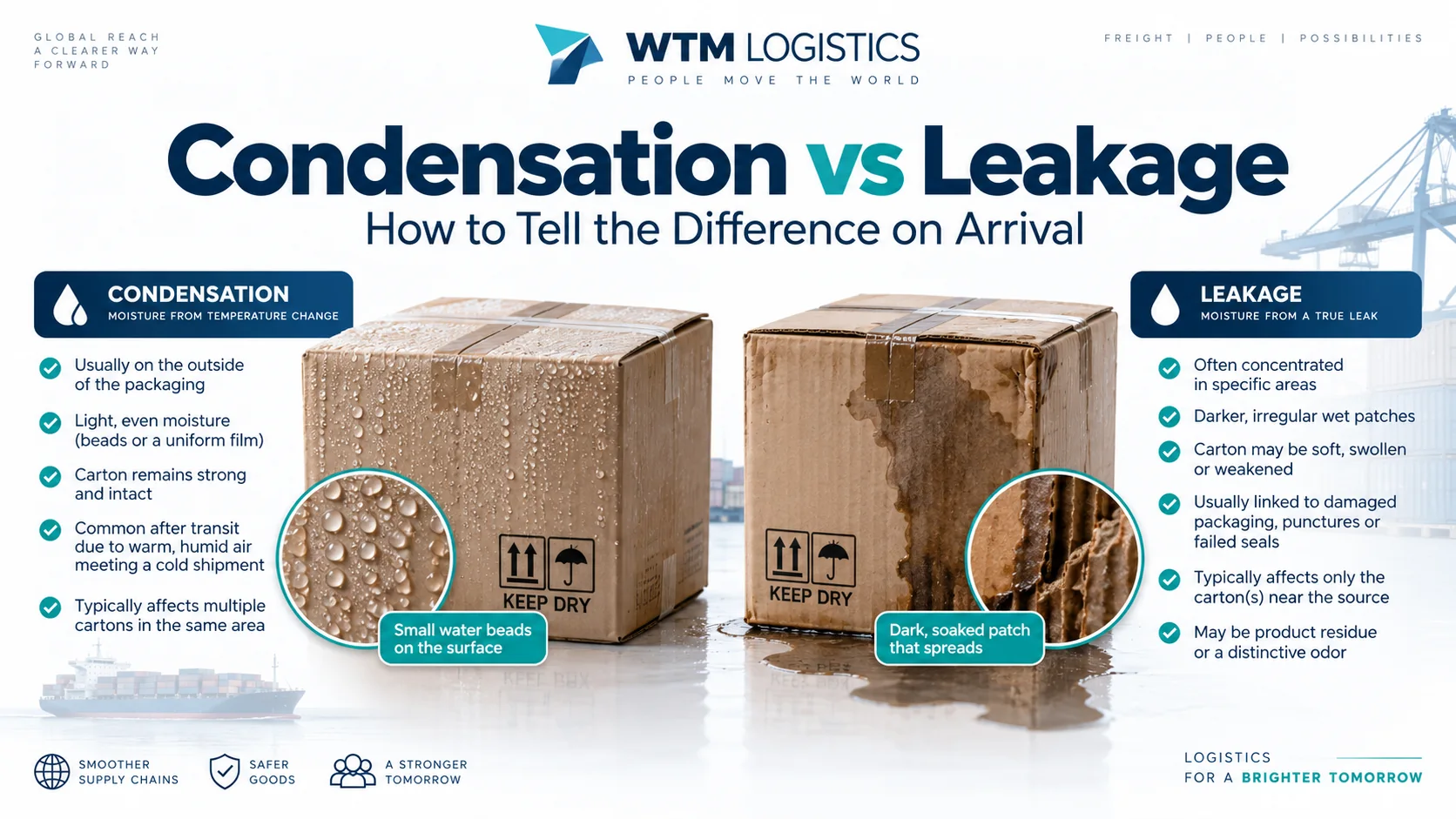
The dew-point idea in plain English
Dew point is the temperature associated with saturation of the air for its moisture content. A colder surface can collect moisture when exposed to that air. The US National Weather Service’s measurement explanation illustrates the principle using a cooled mirror on which condensation forms.
Applying that physics to freight, a cold metal item brought into warmer moist air can become wet even without rainfall entering the vehicle. That is a possible mechanism, not a diagnosis of any particular delivery.
A temperature-change example
Assume the receiving room’s measured dew point is 12°C and a freight surface is at 5°C. The surface is below the dew point, so condensation is possible as room air contacts it. If another surface is 18°C under the same conditions, that particular temperature comparison does not support condensation there.
The example intentionally starts with a known dew point. Room temperature alone is not enough to calculate it, and a phone weather report is not a substitute for conditions at the actual receiving location.
Record before assigning a cause
Photograph the affected area, the wider package and the delivery position. Preserve the shipment reference. Describe what is visible: for example, “droplets on exposed metal at receipt” is more useful than stating “truck leaked” without supporting observations.
If water might affect product condition, follow the product owner’s receiving process and obtain its instructions. A courier POD records the handoff; it does not decide whether sensitive goods may be used. Do not erase the evidence through undocumented repacking or disposal.
Plan temperature transitions with the product owner
A packaging or product specialist can assess barriers, acclimatisation and handling methods for the actual goods. There is no single waiting period or wrapping method suitable for everything from machinery to food.
When requesting WTM transport, describe sensitivity to moisture and temperature, not simply “keep dry.” Explain what receiving conditions the product requires so the journey and handoff can be planned together.
Can condensation happen inside packaging?
It can be a possibility when enclosed air, moisture and temperatures allow it. The packaging arrangement and evidence need to be examined; outside droplets do not prove an inside condition.
Does wet packaging prove the goods are damaged?
Not automatically, but it is an observation worth recording and assessing. Product condition should be evaluated through the appropriate receiving process, not inferred from one photograph.