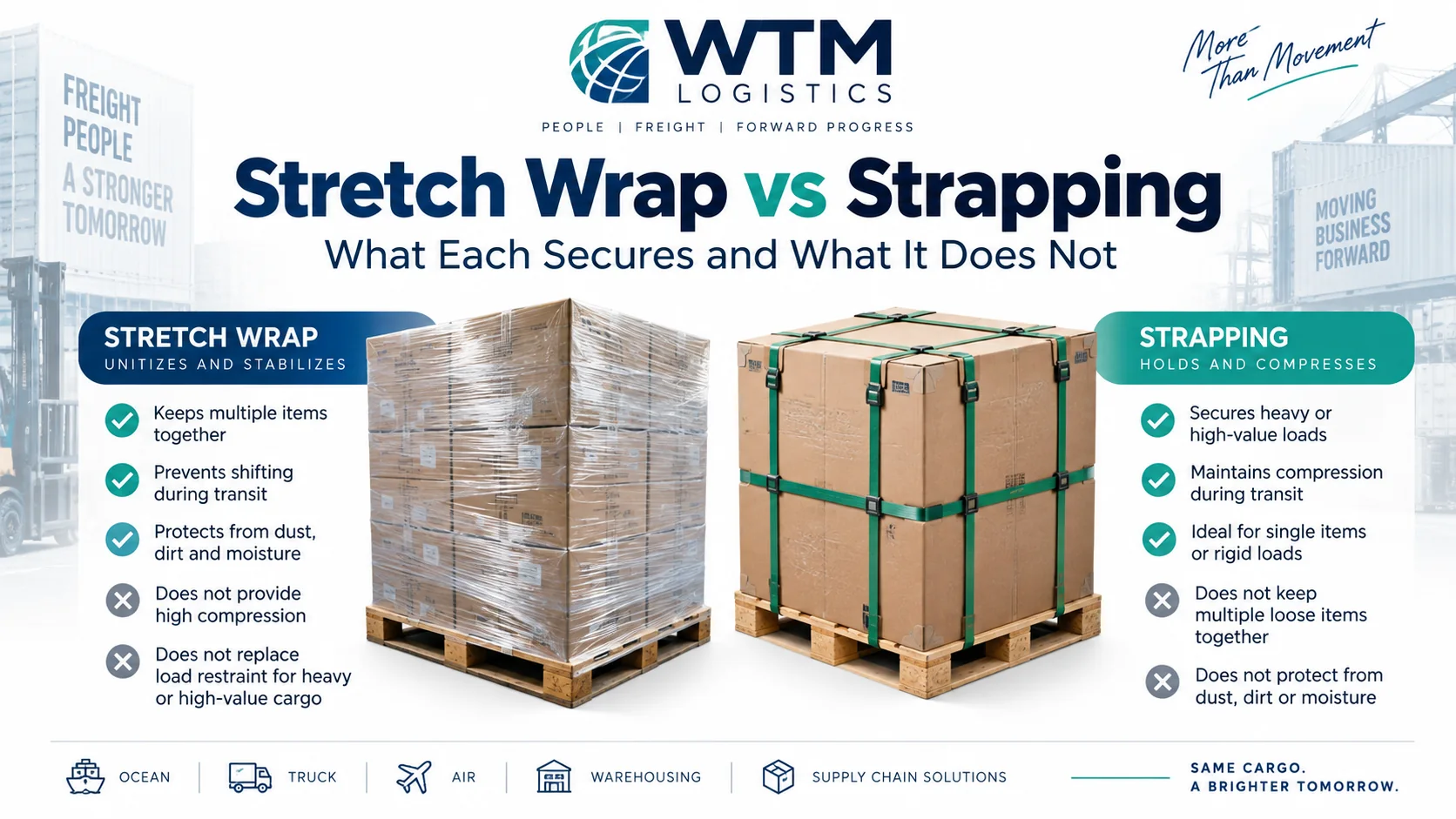
Stretch wrap primarily helps contain a group of items; strapping can help attach and hold a load to its base. They may be used together, but neither should be selected only because the finished pallet looks tidy. The package needs a plan for the particular goods, pallet and handling process.
By WTM Logistics · Practical explanation with primary-source references and clearly labelled examples
Conceptual comparison of pallet packaging methods. Refer to the article for packaging and load-restraint distinctions. Click the image to enlarge.
Identify the job before choosing the material
Is the problem loose cartons, a heavy unit moving relative to its base, exposed edges, or a fragile finish? Those are not the same packaging task.
FedEx’s freight-packing guidance describes both stretch wrapping and banding, with protective materials where appropriate. It treats the load and pallet as a packaging system. Carrier-specific instructions still apply to the relevant service; this guide does not turn another carrier’s specifications into WTM rules.
Packaging element
Intended question
Limitation to check
Stretch film
Will individual packages remain contained as one group?
Is the load also connected appropriately to its base?
Strapping or bands
How is the load held together or attached?
Can the contact force damage the package or product?
Edge protection
How are contact forces and exposed corners managed?
Does the protection suit the package geometry?
Blocking or a designed cradle
What stops a shaped item moving on its support?
Has the whole arrangement been designed for the item?
Compare two fictional loads
A pallet of closed cartons presents multiple units that need to stay together. A single machine on a transport base presents a different problem: containing cartons with film is not equivalent to holding that machine on its supports.
Describe the movement you are trying to prevent. “Use more wrap” gives little guidance if the failure was the product sliding relative to the pallet. “Secure it” is also incomplete if the restraint damages a finished surface. A packaging supplier needs the geometry and handling scenario to recommend the system.
Packaging restraint is not vehicle restraint
Holding the goods to a pallet does not independently establish how the pallet is restrained inside a vehicle. Those are separate interfaces. Do not treat a band’s printed strength as a completed transport-securement design or assume wrapped freight can be loaded without further review.
WTM needs the complete packed load description, including unusual shape and handling restrictions. Appropriate transport arrangements depend on the actual shipment, not only whether it has plastic around it.
Make the method repeatable
Record the material type, packing arrangement and inspection points in your own packing specification. Include a photograph or clear written description of the accepted finished configuration. When an order changes from four cartons to a tall mixed stack, review whether the same method still addresses the same problem.
Look for loose components, damage at contact points and an unclear connection to the base. These are prompts for review, not an invitation to conduct an unsafe tilt or handling experiment with a loaded pallet.
Is shrink wrap the same thing as stretch wrap?
They are different material/application approaches. Use the packaging supplier’s terminology and instructions instead of ordering an unspecified “wrap” and assuming identical performance.
Should every pallet be banded?
Not as a universal rule. The appropriate combination depends on the product, package and service requirements. Obtain a complete packing method rather than a one-material answer.
Use the WTM Customer Portal to request a shipment, review and approve the quote, pay online and follow real-time GPS tracking. Find issued BOLs, PODs, invoices and shipment history in your account. For a new invitation, email admin@wtmlogistics.com.
Get a shipping quote
Send the details of your actual shipment. WTM’s quote-response commitment is within 15 minutes.